Side Project · iOS App · Live on App Store · July 2026
Crowd Tracker SG
Live crowd intelligence for Singapore's ActiveSG pools and gyms — from zero public API to a launched iOS app with real-time alerting. Solo-built and operated end to end: backend architecture, data pipeline, iOS app, infrastructure, monitoring, and App Store launch.
The App
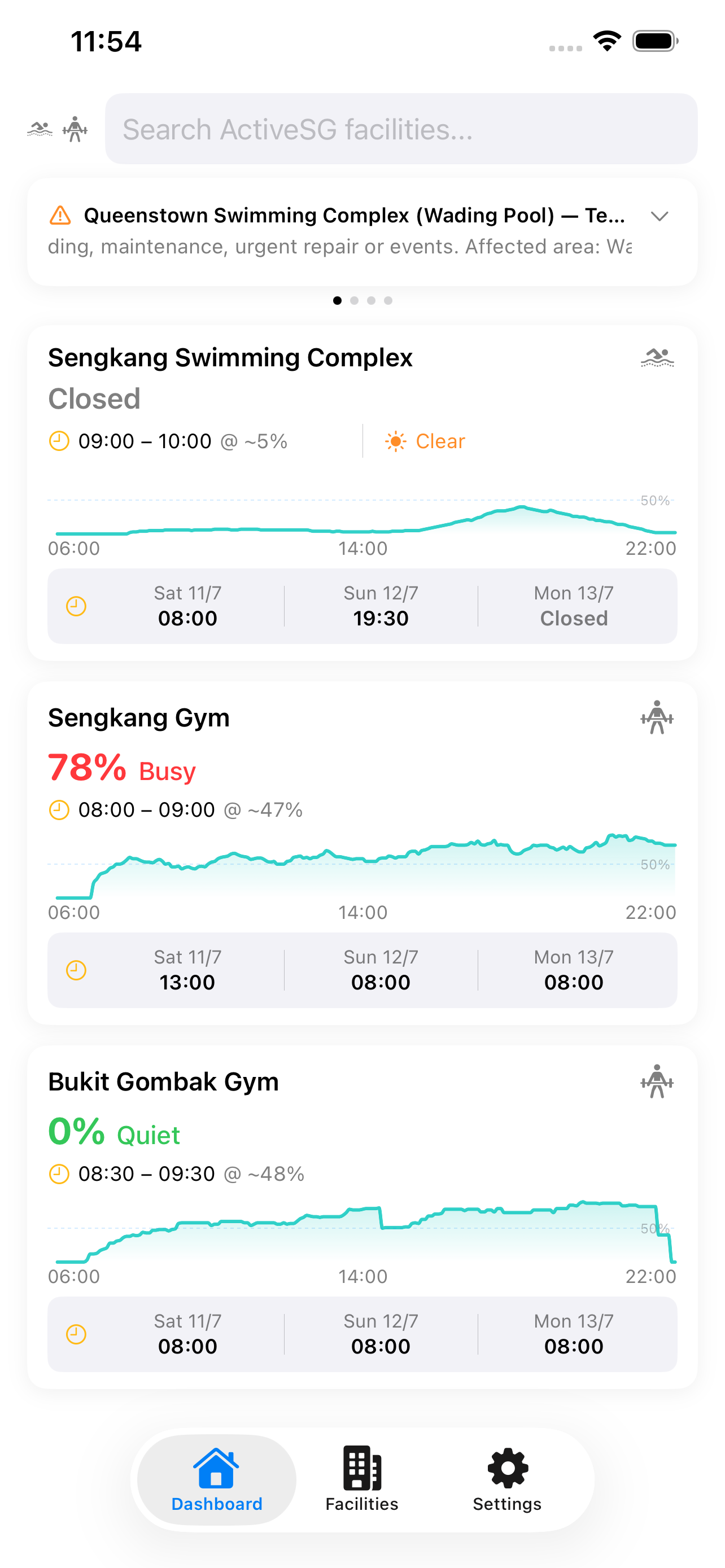
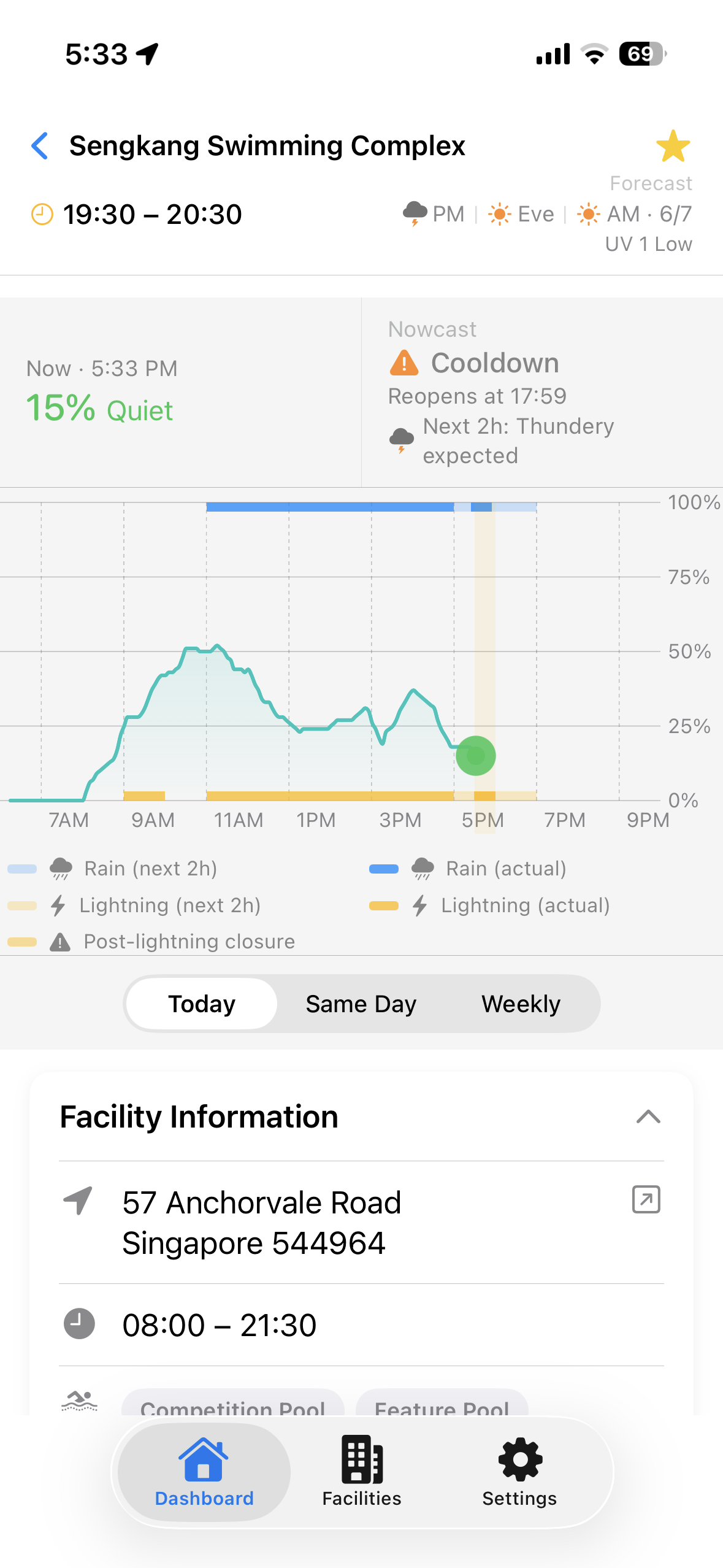
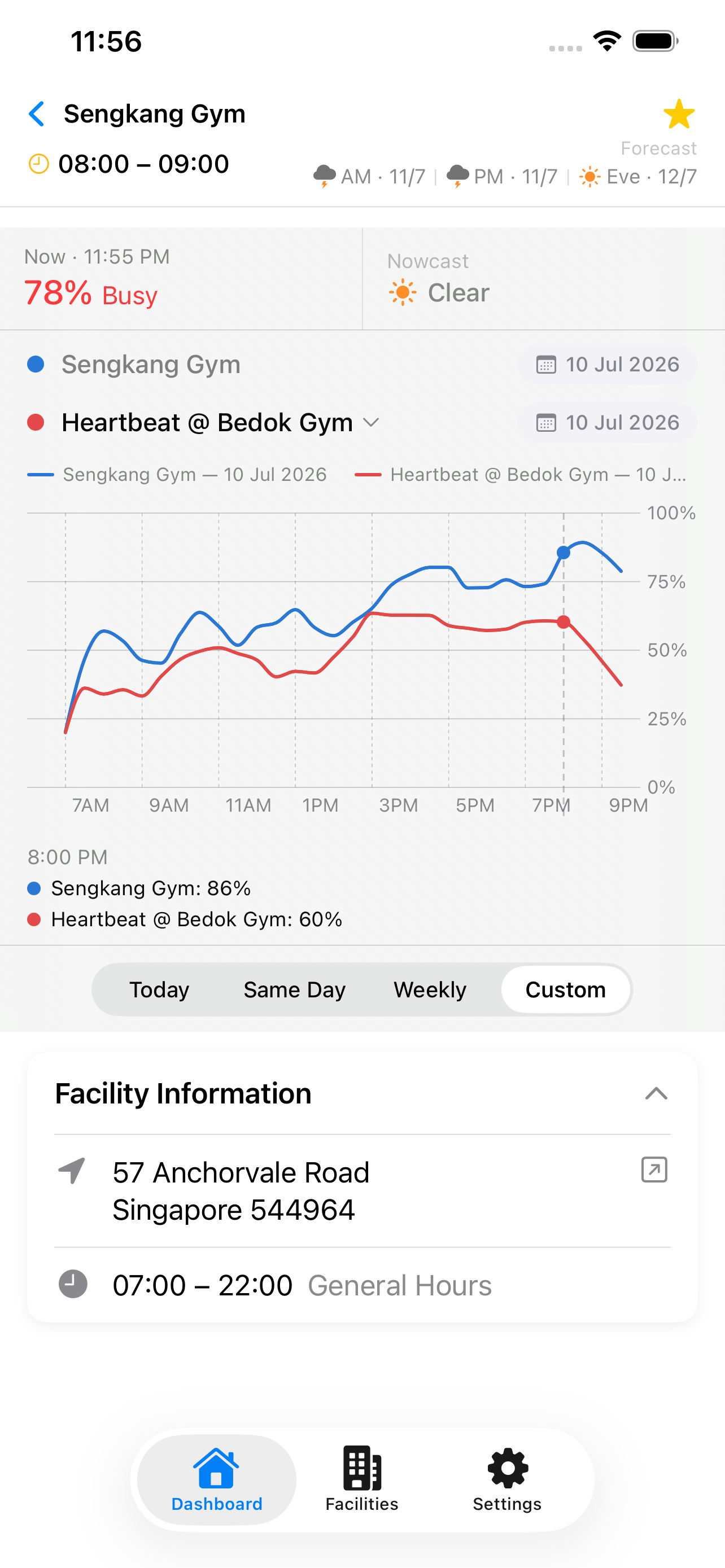
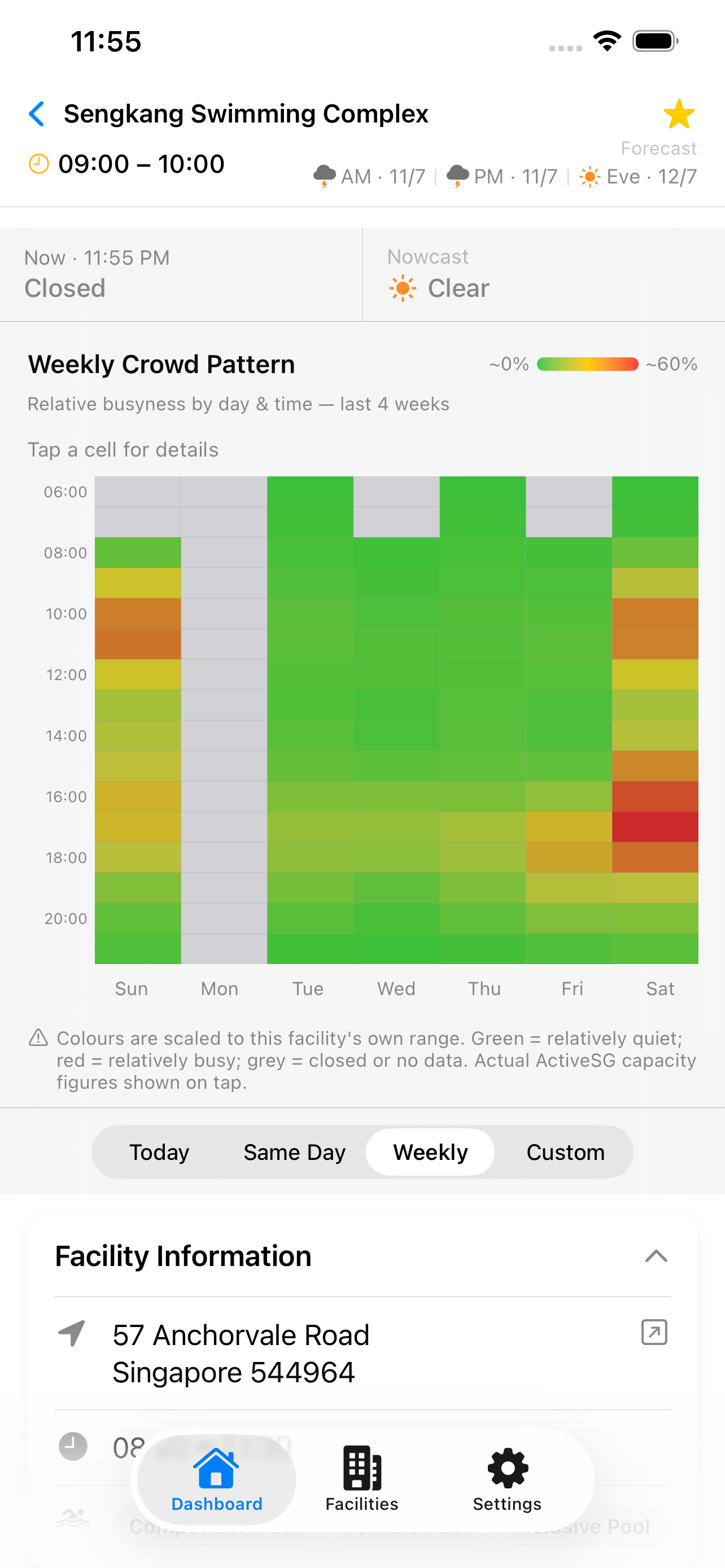
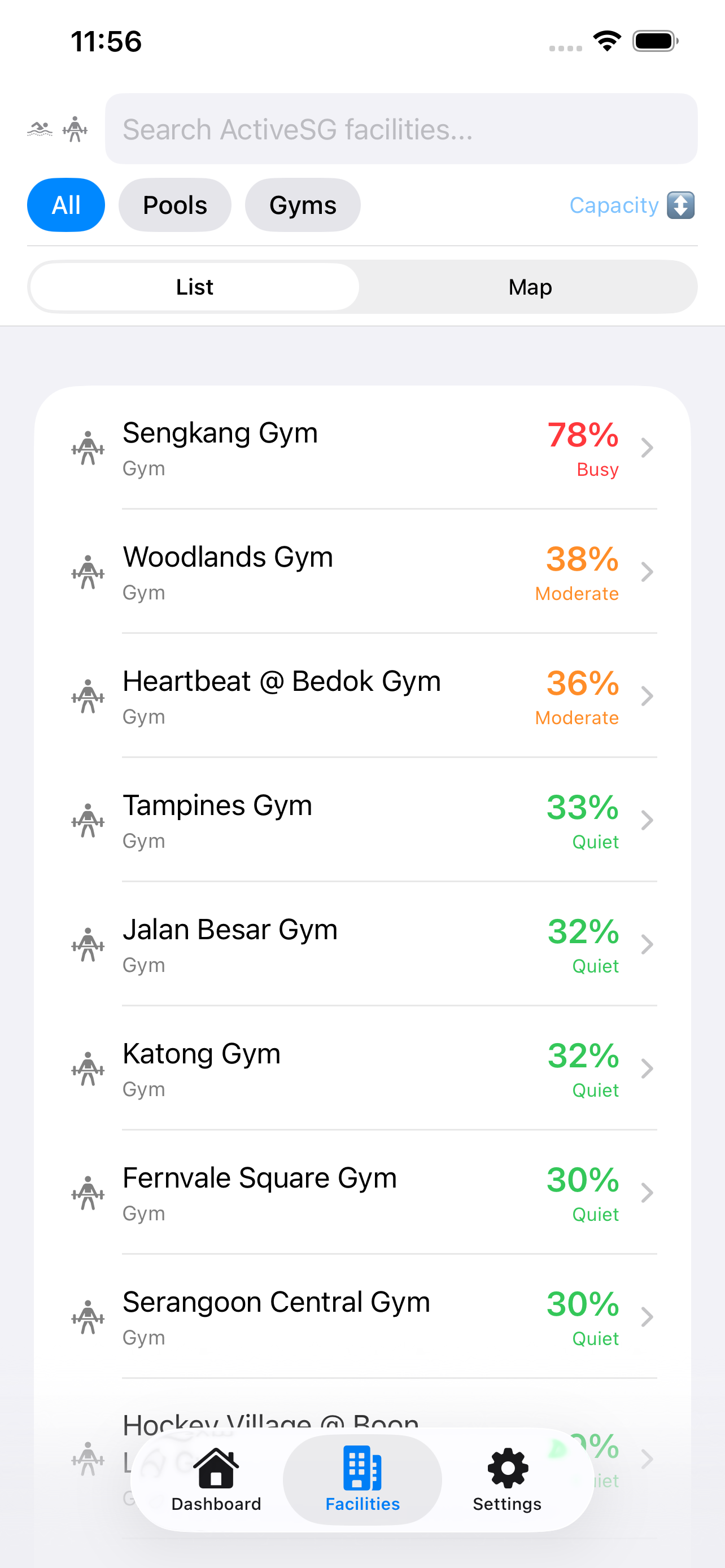
Live crowd levels, historical trend charts, weekly heatmaps, facility comparisons, weather overlays, and per-facility push alerts — across every ActiveSG pool and gym in Singapore.
The Problem
ActiveSG shows live crowd levels on its own page — but only right now, no history, no trend, no way to know whether a Tuesday morning is reliably quiet or always packed. There's no public API. Crowd Tracker SG fills the gap: real-time tracking, historical pattern analysis, weather-aware alerts, and best-time predictions across every pool and gym in Singapore.
The core insight was that the right question isn't "how busy is it now?" — it's "if I leave in 45 minutes, what will it be like when I get there, and is today tracking differently from a typical Thursday?" That requires history, context, and prediction. None of that existed.
Architecture — Dual-Environment Design
The most interesting architectural decision was splitting the system across two environments by function, not by scale. ActiveSG has no public API — the data is scraped from their live crowd page via headless Chromium (Playwright). Cloud datacenter IPs are blocked by ActiveSG's infrastructure. The solution was deliberate:
OVHCloud VPS · Singapore
- Customer-facing FastAPI (REST)
- PostgreSQL — historical crowd storage
- Redis — rate limiting and session state
- Caddy — reverse proxy and TLS termination
- Prometheus + Grafana monitoring
Raspberry Pi 4 · Residential IP
- Playwright poll agent — headless Chromium
- sshuttle tunnel to sg3 for API writes
- NEA weather API integration
- 5-minute polling during operating hours
The Pi's residential IP is undetected by ActiveSG's bot-blocking — the scraping
workload stays there, while the customer-facing API runs on production infrastructure
with a real SLA. Traffic from the Pi is tunnelled to sg3 via sshuttle,
keeping the serving layer entirely cloud-hosted while the data collection layer
operates from a residential connection that doesn't trigger blocks.
Data Pipeline
- Polling: Playwright intercepts ActiveSG's internal API calls rather than scraping rendered HTML — more stable against layout changes and lower overhead. Runs every 5 minutes during operating hours (06:15–22:00 SGT).
- Predictions: Nightly batch jobs compute historical best-time recommendations per facility per day-of-week, with automatic accuracy verification exported to Prometheus for ongoing monitoring.
- Holiday awareness: public holidays and school holiday weekdays automatically map to the correct historical comparison day — a Monday public holiday uses Sunday's crowd pattern, not Monday's.
- Weather integration: NEA rainfall, lightning, and nowcast APIs cross-referenced against each facility's geolocation for pool-specific weather overlays and lightning-closure detection.
Real-Time Alerting System
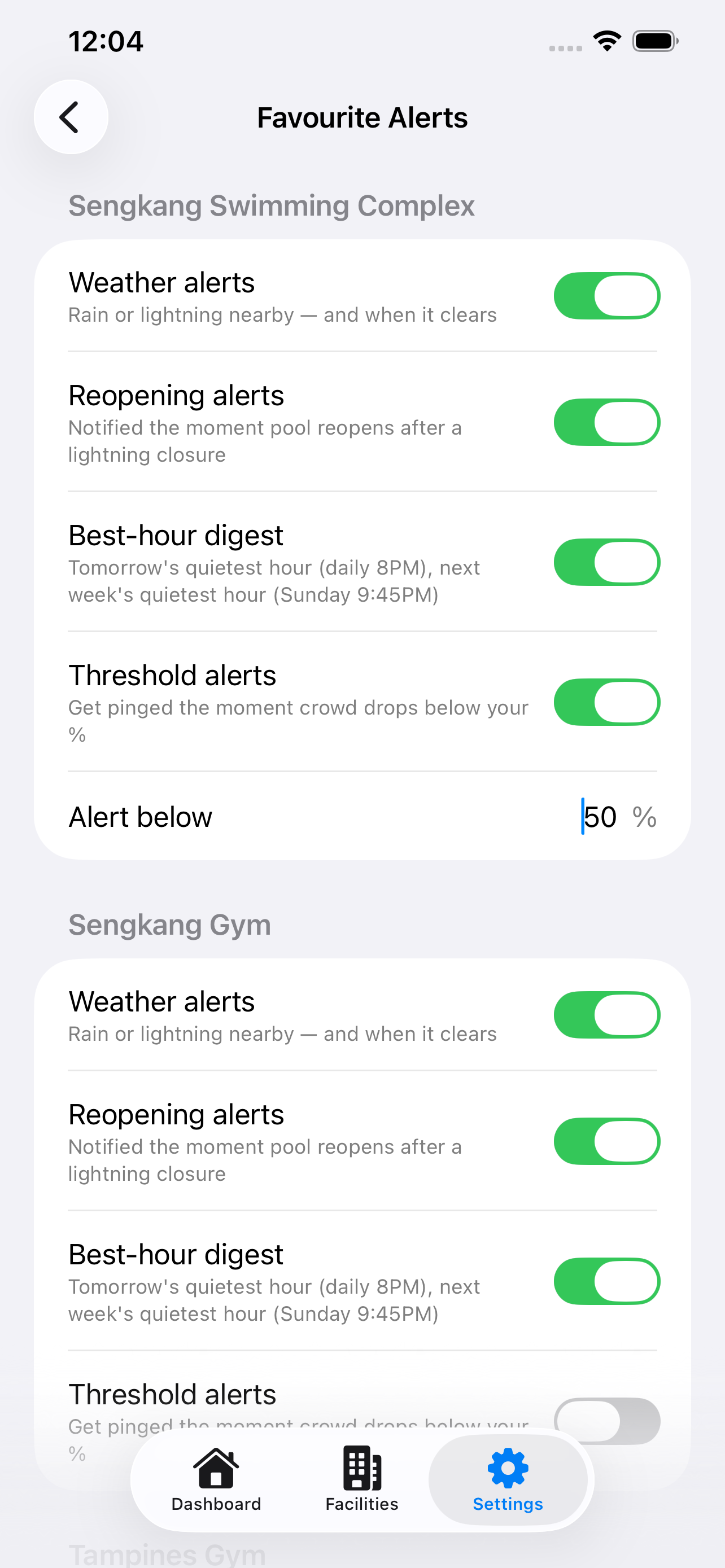
Five independently-tuned push notification types, delivered via Apple Push Notification service (APNs):
| Alert type | Behaviour |
|---|---|
| Threshold-crossing | Fires when a favourited facility's crowd drops below a user-set percentage. Asymmetric hysteresis prevents rapid re-fire when capacity oscillates at the boundary — the alert re-arms only after crowd rises to threshold + buffer. |
| Weather (bidirectional) | Rain or lightning detected and cleared. A 2-cycle debounce (2 × 5-minute polls) filters single-detection flicker without meaningfully delaying real weather changes. Validated against a live weather event during pre-launch testing. |
| Reopening | Fires the moment a facility reopens after a lightning closure — the specific piece of information regular visitors genuinely can't predict from experience alone. |
| Daily best-hour digest | Evening notification (8PM) with tomorrow's predicted quietest hour per favourited facility. |
| Weekly best-hour digest | Sunday-evening summary of the coming week's best day and hour across favourites. |
Security & Data Integrity
Authentication
- Device-secret auth — a server-issued secret paired with a client-generated installation ID, replacing an earlier scheme vulnerable to spoofing
- JWT-based tier verification for premium features, with real Apple App Store Server API validation of purchase receipts (sandbox and production)
- CORS lockdown and scoped token expiry — hardened from an initial open configuration before public launch
Rate Limiting & Privacy
- Redis-backed rate limiting per-IP and tier-aware, with a documented allowlist for known infrastructure — added after a real incident where shared NAT collapsed monitoring and dev traffic into one rate-limit bucket
- No accounts, no PII — favourites and alert preferences are tied to an anonymous device identifier only. Deliberate privacy-by-design, not a deferred concern.
Monitoring & Observability
- Prometheus + Grafana — ops dashboard covering API latency (p50/p95/p99 by endpoint), poller health and staleness detection, Caddy request and error rates, NEA data-source health, cache performance, and authentication and rate-limit failure visibility.
- Structured JSON logging — replaced default framework logging with custom middleware capturing real client IP (correctly resolved through the Caddy reverse proxy), request duration, and resolved subscription tier per request. Closed a real observability gap where internal container IPs were previously indistinguishable from actual client traffic.
- Telegram alerting on infrastructure health: poller-down detection and a separate "poller stalled" alert — the distinction between "process crashed" and "process running but silently stuck" are two different failure modes deliberately monitored independently.
Notable Engineering Problems Solved
Three representative examples of debugging depth that go beyond typical CRUD work:
Silent purchase-verification failure
Root-caused a purchase verification failure to a local Xcode testing configuration transparently intercepting App Store transactions — traced through client logs, server logs, and Apple's own API error responses to distinguish "testing artifact" from "real production bug" before shipping. Would have been invisible without structured, correlated logging across the iOS client and the API.
Device-identity desync bug
Diagnosed authenticated requests silently failing by correlating client-side Keychain state, server-side database rows, and direct API reproduction via curl. Isolated the root cause to iOS code-signing churn during development — not a risk to real users — before deciding whether it warranted a fix rather than a workaround.
Production-breaking configuration gap
Caught during final pre-release review: an environment variable controlling Apple sandbox-vs-production purchase verification was silently defaulting to sandbox in the deployed container despite being set correctly in the environment file. Would have broken every real customer's first purchase had it shipped unnoticed. Found by reviewing the running container's resolved environment, not just the source config.
Business Model
Running a backend that polls every 5 minutes across dozens of facilities, stores months of history, and fires push notifications has real infrastructure costs. I built a freemium model via StoreKit 2 rather than making the free version useless. The free tier is genuinely useful on its own — the paid tier funds the backend.
- Live crowd levels for all facilities
- Today's crowd chart
- Weather and lightning-closure alerts
- Pool reopening notifications
- Next 3 best-hour predictions
- Full historical patterns — same-day and weekly heatmap
- Facility-to-facility comparisons
- Custom date range views
- Threshold alerts (crowd drops below your %)
- Daily and weekly best-hour digest